https://docs.google.com/document/d/12KiCJANo5TzrK2vll-1Hga7feJap3AZTodVCoFv4Zqg/edit?hl=en_GB#
SILA klik link di atas.. trima kasih :)
Thursday, 8 December 2011

SEJARAH PERKEMBANGAN KAMERA
APA ITU KAMERA?


Kamera ialah alat yang digunakan untuk merakam imej sebagai gambar atau foto yang pegun serta satu susunan imej bergerak(filem atau video). Kamera masa kini berevolusi dari kamera pertama yang tercipta iaitu kamera obscura di ambil dari istilah bahasa latin yang bermaksud “bilik Gelap” serta satu mekanisma awal bagi memaparkan imej yang mana seluruh bilik yang berfungsi sebagai system penghasilan imej tepat pada masa. Kamera obscura ini mula di cipta oleh saintis muslim bernama Abu Ali Hasan Ibn Al-Haitham.
Kamera boleh berfungsi melalui cahaya spektrum nyata atau melalui bahagian-bahagian lain pada spektrum elektromagnetik. Sesebuah kamera biasanya mempunyai sejenis rongga dengan satu bukaan di sebelah bagi memasukkan cahaya, dan satu permukaan rakaman atau pandangan bagi menangkap cahaya itu pada sebelah yang lain. Kamera mempunyai lensa yang terletak di hadapan bukaan kamera untuk mengumpul cahaya yang masuk dan untuk memfokuskan imej atau sebahagian imej pada permukaan rakaman. Diameter bukaan itu biasanya dikawal oleh satu mekanisme diafragma, namun ada kamera yang mempunyai bukaan bersaiz tetap. Pada masa kini, terdapat beberapa jenis kamera. Bermula dari obscura, kemudia ke kamera filem dan seterusnya berevolusi ke SLR dan DSLR. Pelbagai jenis kamera pada masa kini iaitu dari jenis Canon, Nikon, Sony, Samsung, dan bermacam-macam lagi. Di bawah adalah gambar kamera pertama yang di hasilkan.
Kamera pertama yang berjaya di hasilkan ialah kamera Obscura, dan ianya merupakan kamera pertama yang berfungsi dan mampu menangkap dan menghasilkan gambar. Namanya di sebut sebagai Obscura yang di ambil dari bahasa latin yang bermaksud ruang gelap. Kamera Obscura merupakan kamera yang diperbuat dalam bentuk kotak dan dapat memantulkan cahaya melalui penggunaan dua buah lensa konveks, kemudian gambar yang di tangkap akan terakam pada sehelai kertas atau filem dan filem tersebut berada pada pusat focus dari lensa tersebut. Kamera Obscura terhasil dari kajian pengkaji muslim yang bernama Abu Ali Hasan Ibn Al-Haitham dan kajianya di tulis di dalam bukunya yang berjudul “Books of Optics”(1015-1021).
Sementara itu, di tahun 1660-an pengkaji yang berasal dari barat iaitu Robert Boyle dan pembantunya yang bernama Robert Hooke menemukan portable kamera obscura. Namun kamera pertama yang praktikal dan berbentuk kecil telah di hasilkan olah Johann Zahn dan penemuan ini berlaku pada tahun 1685. Kamera pada awalnya banyak menerapkan prinsip model Zhann di mana ianya perlu menggunakan slide tambahan yang di gunakan untuk memfokuskan objek yang ingin di rakam. Cara penggunaan system tersebut adalah dengan menambahkan sebuah plat sensitive di hadapan lensa kamera yang di gunakan sebelum melakukan pengambilan gambar.


Perkembangan kamera terus berlanjutan, dan Jacques Daguerre merupakan salah seorang yang berperanan dalam perkembangan teknologi kamera. Daguerre di lahirkan pada tahun 1787 di Cormeilles di Perancis Utara. Semasa masih muda, beliau merupakan seorang seniman. Apabila berumur 30-an, beliau mendapat satu idea apabila beliau mempamerkan hasil lukisan pemandanganya dengan bantuan kesan cahaya. Beliau berasa tertarik apabila melihat perkembangan satu mekanisma yang menyebabkan beliau ingin menghasilkan lagi satu lukisan yang sama tanpa perlu melukis dan mewarnakan semula. Erti kata lainya beliau ingin lukisan di buat secara outomatik sahaja. Beliau merasakan ini mungkin terjadi dengan bantuan kamera.
Pada tahun 1827, Daguerre bertemu dengan Joseph Nicephore Niepce yang juga sedang mencuba untuk menghasilkan kamera dan mereka berdua bekerjasama dalam membuat kajian mengenai kamera. Namun pada tahun 1833 Niepse meninggal dunia. Daguerre tetap melanjutkan kajianya dalam pembuatan kamera. Pada tahun 1837, Daguerre berhasil menghasilkan sebuah sistem praktikal fotografi yang di kenali sebagai “Daguerreotype”. Pada tahun 1839 Daguerre mengumumkan secara terbuka kepada orang ramai tentang kejayaanya dalam kajianya mengembangkan teknologi kamera. Beliau menjadi terkenal di waktu itu dan hasil kajianya dengan cepat berkembang dan banyak di gunakan oleh khalayak. Pada tahun 1851 di tempat asal kelahiranya Daguerre meninggal dunia.
Obscura telah diubahsuai sehinggalah tercipta kamera Kodak oleh George Eastmen pada tahun 1888. yang lebih kecil. Pada zaman ini wujud kamera lebih kecil dan yang terkini ialah kamera digital. Gambar di bawah menunjukan kamera Kodak yang terawal di hasilkan dan namanya di sebut sehingga ke hari ini.


Tahun 1900 seorang Jurugambar telah mencipta kamera Mammoth (lihat gambar diatas). Kamera ini amat besar ukurannya dimana beratnya 1,400 pound. Lensa seberat 500 pound. Sewaktu mengubah atau memindahkannya tenaga manusia seramai 15 orang diperlukan. Kamera ini menggunakan filem sebesar 4 ½ x 8 kaki dengan bahan kimia sebanyak 10 gallons digunakan ketika memprosesnya.
Obscura telah diubahsuai sehinggalah tercipta kamera Kodak oleh George Eastmen pada tahun 1888. yang lebih kecil. Pada zaman ini wujud kamera lebih kecil dan yang terkini ialah kamera digital. Gambar di bawah menunjukan kamera Kodak yang terawal di hasilkan dan namanya di sebut sehingga ke hari ini.
Diawal kewujudan kamera digital tidak ramai menggemarinya terutama kalangan profesional. Ini kerana kamera digital generasi awal sekitar hujung tahun 1980an, masih menggunakan ciri-ciri kamera kompak. Kamera digital waktu itu kecil, ringan dan kemampuan imej tidak memenuhi kehendak profesional. Namun begitu sekitar awal 2000 kamera digital direka dengan mengambil kira selera profesional. Akhirnya kita telah memperolehi kamera digital dalam format SLR (Single Lens Reflex). Gambar di bawah menunjukkan jenis camera SLR yang terawal.


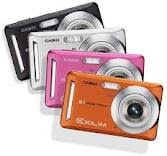
CONTOH DLSR DAN KAMERA DIGITAL YANG MUDAH DIBAWA
Sumber:
http://id.wikipedia.org/wiki/Fotografihttp://tarmizishukri.com/fakta/sejarah-perkembangan-kamera
http://images.google.com/search?hl=en&q=dslr&biw=1366&bih=551&sei=5ezgTp_fAcn4rQexwdinCw&tbm=isch
http://www.telepay.ch/pages/glossar/g-digifot.htmlhttp://images.google.com/search?hl=tbm=isch#hl=en&tbm=isch&sa=1&q=kamera+mammoth&oq=kamera+mammoth&aq
http://en.wikipedia.org/wiki/Single-lens_reflex_camera
http://www.canon-asia.com/ixus230hs/
http://www.canon.com.my/personal/products/compact-cameras?languageCode=EN&gclid=CLrm-tL88qwCFUF66wodBTNNYwTutorial A: Huraikan sejarah dan intipati sikap 'Luddites' dan 'Determinists' terhadap teknologi
HISTORY OF THE LUDDITES
The Luddites were a social movement of 19th-century English textile artisans who protested – often by destroying mechanised looms – against the changes produced by the Industrial Revolution, which they felt were leaving them without work and changing their way of life. The movement was named after General Ned Ludd or King Ludd, a mythical figure who, like Robin Hood, was reputed to live in Sherwood Forest.
Mobs roamed the Industrial towns of northern England, smashing looms and frames and burning factories. The Luddites, a band of nineteenth century English handicraftsmen, were rioting in protest to the textile machinery that had taken them out of business. In the early eighteen hundreds, in the well known counties of Yorkshire, Lancashire, Cheshire, Derbyshire, and Nottinghamshire, Luddites destroyed thousands of pieces of machinery until they finally met their own demise around 1817 and the government was able to control Luddites riots.
During the Industrial Revolution, the laws and customs, which had been installed to protect the working class of England, were ignored and eventually abandoned. For example, the Minimum Wage Bill of 1808 decreased minimum wage and the Combination Acts, banned trade unions, as well. These were just some of the many sparks which drove the Luddites to rebellion.
As new machinery was being introduced, the wages of skilled workers dropped and working conditions began to deteriorate. The lives of the Luddites and their families were in danger. Therefore they decided to turn to Ned Ludd who is often perceived as a fictional character. Many say that Ned Ludd was an apprentice who smashed his bosses shearing frame with a hammer, possibly only to protect himself. Nonetheless he became known as a "lunatic" and the leader of Luddism. There were several aspects that led to the downfall of the Luddites. In 1812, a law was passed by the House of Lords, called the Frame-Breaking Act. This act made the breaking of frames punishable by death. Many Luddites members were not ready to give up their lives, therefore they abandoned the group. Trade unions became legal and male workers were slowly gaining the right to vote. The movement of the Luddites were becoming more and more pointless.
The government eventually defeated the Luddites. As many as forty Luddites were killed in action, twenty-four were executed, thirty-four were transported to Australia and twenty-four were imprisoned. Although the rise of the Luddites was short lived, they impacted society a great deal and even today Luddism is still around.
TURNING POINT IN HISTORY
Many historians would deem the Luddite riots as unsuccessful, while many others would say that they had a huge impact on society. The Luddites changed the views of people during the Industrial Revolution. They brought the rights of the workers to the attention of England. A turning point in history is often thought of as a well-known and dramatic event that took place and completely changed the world. The riots of the Luddites are not very well-known. However, their actions led to many significant changes in the world.
Politically, the actions of the Luddites brought the idea of having a society based on industrialization into the eyes of the public and open to debate. People were forced to look more closely at the positive and negative effects of having an industrial society. The "machine question" continues tobe unanswered today. The riots became a turning point because the flaws of the Industrial Revolution were brought to the surface and the government could no longer ignore the opinions of the working class.
The Luddites stories circulated England, showing the strong resistance and bravery of the English men. People realized that if one is disciplinedand organized, he will be successful in his battles. The Luddites als brought about the ideas that technology is never neutral and some are even hurtful. For example, while the while the Spinning Jenny was beneficial to the textile industry, it also put several spinners out of business. The Luddite rebels uncovered the dark side to the Industrial Revolution!
THE NEO-LUDDITES
Who are the Neo-Luddites? The Luddites anti-technological view which began in the 1800s has continued to bring forth an uprising of tensions in todays society. There are no set rules or guidelines on what it takes to be a Neo-Luddite. However, the term is most often used to refer to those who are opposed to the advance of technology in our society, not necessarily with violence and sabotage.
Kirkpatrick Sales is a well-known leader of Neo-Luddism today. His most famous book is known as "The Luddites: Rebels Against the Future." He believes that the advance of technology will someday lead to the downfall of the world. A similar figure to Sales is a man who is known worldwide as the Unabomber. He went to the extreme by bombing several places in order to promote his anti-technological view. The Neo-Luddites today have one main difference from the original Luddites. The Luddites of the 1800s were fighting for their lives, whereas today they are just fighting for a return to simpler times.
LUDDITES AND LUDDISM HISTORY This historical overview is an extract from Kevin Binfield, ed., Writings of the Luddites (Baltimore and London: The Johns Hopkins University Press, 2004). No part of this page may be reproduced in any form without the written permission of Kevin Binfield. Few groups have been more misunderstood and have had their image and name more frequently misappropriated and distorted than the Luddites. The Luddites were not, as not only popularizers of theories of technology but also capitalist apologists for unregulated innovation claim, universally technophobes. The Luddites were artisans -- primarily skilled workers in the textile industries in Nottinghamshire, Derbyshire, Leicestershire, Cheshire, the West Riding of Yorkshire, Lancashire and Flintshire in the years between March 1811 and April 1817 -- who when faced with the use of machines (operated by less-skilled labor, typically apprentices, unapprenticed workers, and women) to drive down their wages and to produce inferior goods (thereby damaging their trades' reputations), turned to wrecking the offensive machines and terrorizing the offending owners in order to preserve their wages, their jobs, and their trades. Machines were not the only, or even the major, threat to the textile workers of the Midlands and North. The Prince Regent's Orders in Council, barring trade with Napoleonic France and nations friendly to France, cut off foreign markets for the British textile industry. Even more importantly, famine and high food prices required more of each laborer's shrinking wages. Machines and the use of machines to drive down wages were simply the most accessible targets for expressions of anger and direct action. The Luddites were not the first or only machine wreckers. Because organized, large-scale strikes were impractical due to the scattering of manufactories throughout different regions, machine wrecking, which E. J. Hobsbawm calls "collective bargaining by riot," had occurred in Britain since the Restoration. For example, in 1675 Spitalfields narrow weavers destroyed "engines," power machines that could each do the work of several people, and in 1710 a London hosier employing too many apprentices in violation of the Framework Knitters Charter had his machines broken by angry stockingers. Even parliamentary action in 1727, making the destruction of machines a capital felony, did little to stop the activity. In 1768 London sawyers attacked a mechanized sawmill. Following the failure in 1778 of the stockingers' petitions to Parliament to enact a law regulating "the Art and Mystery of Framework Knitting," Nottingham workers rioted, flinging machines into the streets. In 1792 Manchester weavers destroyed two dozen Cartwright steam looms owned by George Grimshaw. Sporadic attacks on machines (wide knitting frames, gig mills, shearing frames, and steam-powered looms and spinning jennies) continued, especially from 1799 to 1802 and through the period of economic distress after 1808. The first incident during the years of the most intense Luddite activity, 1811-13, was the 11 March 1811 attack upon wide knitting frames in a shop in the Nottinghamshire village of Arnold, following a peaceful gathering of framework knitters near the Exchange Hall at Nottingham. In the preceding month, framework knitters, also called stockingers, had broken into shops and removed jack wires from wide knitting frames, rendering them useless without inflicting great violence upon the owners or incurring risk to the stockingers themselves; the 11 March attack was the first in which frames were actually smashed and the name "Ludd" was used. The grievances consisted, first, of the use of wide stocking frames to produce large amounts of cheap, shoddy stocking material that was cut and sewn into stockings rather than completely fashioned (knit in one piece without seams) and, second, of the employment of "colts," workers who had not completed the seven-year apprenticeship required by law. (For those laws, see the page on "Interpretations.") Frames continued to be broken in many of the villages surrounding Nottingham. The 23 March 1811 and 20 April 1811 Nottingham Journal reports several weeks of almost nightly attacks in the villages, all successful and carried out without one attacker's being arrested. The summer of 1811 was quiet, but a bad harvest helped to renew disturbances in November, when, as the story goes, stockingers assembled in the wooded lands near Bulwell and were led in attacks on a number of shops by a commander calling himself Ned Ludd. Letters from Midlands correspondents to the Home Office report a number of riotous disturbances, including the burning of haystacks and "an anonymous letter received by a Magistrate threatening still greater acts of violence by fire." Letters dated 13 and 14 November 1811 request that the government dispatch military aid because "2000 men, many of them armed, were riotously traversing the County of Nottingham." In December 1811 public negotiations between the framework knitters and their employers, the hosiers, some of which were carried out in the two Nottingham newspapers, failed to result in the return of wages, piece rates, and frame rents to earlier levels or in any satisfactory amelioration of the framework knitters' economic circumstances. Frame breaking continued in the Midlands counties of Nottinghamshire, Derbyshire, and Leicestershire through the winter and early spring of 1812. It resurfaced in 1814 and again in Leicestershire in the autumn of 1816. The first signs of the spread of Luddism to the cotton-manufacturing center of Manchester and its environs in Lancashire, Cheshire, and Flintshire materialized in December 1811 and January 1812. Manchester Luddism has traditionally been understood as having centered on the cotton-weaving trade, which had failed in an attempt to organize in 1808, and which was suffering from the use of steam-powered looms to decrease the wages of skilled weavers at a time of rising food prices and depressed trade; however, documents that I have discovered in the McConnell, Kennedy and Company papers and Home Office documents that have been entirely overlooked by previous scholars indicate that Luddites were active in defense of the spinning trade, too. (For those documents, see Chapter 3 of Writings of the Luddites.) In Manchester, unlike Nottingham, the offensive machinery was housed in large factories. Luddite raids in and around Manchester tended to be carried out by large numbers of attackers and also often coincided with food riots, which provided crowds that were large enough to carry out the factory attacks and that came from a broadly distressed population ready to take action. Luddite activity continued in Lancashire and Cheshire into the summer of 1812 and blended into efforts to establish larger trade combinations and into political reform, but the force of Luddism dissipated following the acquittal of dozens of accused Luddites in Lancaster later that year and the administration of loyalty oaths coupled with royal pardons conditioned upon the taking of those oaths. The factory owners and cloth merchants of the woolen industry in the West Riding of Yorkshire were the targets of Luddism in that county. Although West Riding Luddites represented a variety of skilled trades, the most active and numerous by far were the cloth dressers, called croppers, whose work was threatened by the introduction of the shearing frame. The croppers' work consisted of using forty- or fifty-pound handheld shears to cut, or crop, the nap from woven woolen cloth in order to make a smooth and salable article. They were threatened by two types of machines. The gig mill, which had been prohibited by law since the rule of Edward VI, was a machine that raised the nap on woolen cloth so that it might be sheared more easily. The shearing frames actually mechanized the process of shearing and reduced the level of skill and experience necessary to finish an article of woolen cloth, even though the machines could not attain the quality of hand-cropped cloth. From January 1812 through midspring, Luddite attacks in Yorkshire concentrated on small cropping shops as well as large mills where frames were used. In April Luddites began to attack mill owners and raided houses and buildings for arms and lead. Luddism began to fail after the failed attack upon Rawfolds Mill and the murder of mill owner William Horsfall by George Mellor and other Luddites. By the next winter, West Riding Luddism had run its course, even though after the January 1813 executions of Mellor and other Luddites a few more threatening letters were sent to public officials. In all three regions, Luddites responded to the distressing concurrence of high food prices, depressed trade caused by the wars and by the trade prohibitions imposed under the Orders in Council, and by changes in the use of machinery so as to reduce wages for the amount of work done. That machinery alone was not the primary cause of Luddite anger is evident in the cessation of Luddism. Luddite activities ended as a result of the rescinding of the Orders in Council, the suppression of the riots by the government's use of spies and the military, some wage and usage concessions, and some reduction in food prices. Despite its brief run, Luddism ought to be understood as E. P. Thompson and J. L. and Barbara Hammond have argued, as an important step in the formation of a class consciousness and the development of labor unions in Britain. Both the appropriation of the term Luddism and the use of the term as an epithet are erroneous; to use the term other than in its historical context is to display ignorance of the particularity of historical conditions. A number of excellent published histories of Luddism are available and are far more reliable and accurate than anything appearing on the internet. J. L. Hammond and Barbara Hammond gleaned the Home Office Papers for their treatment of Luddism in The Skilled Labourer (1919 -- indispensible). E. P. Thompson's landmark study, The Making of the English Working Class (1963 -- indispensible), considers Luddism in its relationship to cotemporaneous Radical and labor movements. Malcolm Thomis's The Luddites (1970 -- indispensible) was the first major study devoted solely to the Luddites. John Rule surveys the various scholarly treatments of Luddism in a chapter of his book The Labouring Classes in Early Industrial England (1986 -- supplemental). Adrian Randall's Before the Luddites (1991 -- indispensible) explores the philosophy of Luddism in its nascent form and considers the differences between the woollen industry in the West of England and the Yorkshire industry, where Luddism flourished. Kirkpatrick Sale's Rebels against the Future (1995 -- cautiously recommended) reinterprets Luddism as a general resistance to technology. The most recent complete history of Luddism is Brian Bailey's The Luddite Rebellion (1998 -- cautiously recommended). The first collection of actual Luddite writings is Kevin Binfield's Writings of the Luddites (forthcoming Spring 2004). Many of these books are available from major booksellers. | ||
DETERMINISM
Determinism is the general philosophical thesis that states that for everything that happens there are conditions such that, given them, nothing else could happen. There are many versions of this thesis. Each of them rests upon various alleged connections, and interdependencies of things and events, asserting that these hold without exception. The wide variety of deterministic theories throughout the history of philosophy have sprung from diverse motives and considerations; some of which overlap considerably. All should be considered in the light of their historical significance, together with certain alternative theories that philosophers have proposed. At the same time, some forms of determinism may be empirically testable, and this page mentions some relevant ideas from physics and the philosophy of physics. The opposite of determinism is some kind of indeterminism (otherwise called "Nondeterminism").
Determinism is the philosophical idea that every event or state of affairs, including every human decision and action, is the inevitable and necessary consequence of antecedent states of affairs.More strictly, determinism should be distinguished from pre-determinism, the idea that the entire past (as well as the future) was determined at the origin of the universe.Nor should determinism be confused with determination, the idea that events (including human actions) can be adequately determined by immediately prior events (such as an agent's reasons, motives, desires), without being pre-determined back to before the agent's birth or even back tothe origin of the universe.
Since modern physics shows that the universe in indeterministic, with profound effects on the atomic scale of microscopic processes, we will find it valuable to distinguish pre-determinism (inevitable causal chains) from the adequate determinism that we have in the real world and obvious in the classical physical laws that apply in the macrocosmos.
Determinism is a modern name (nineteenth-century) for Democritus' ancient idea that causal laws control the motion of atoms, and that everything - including human minds - consists merely of atoms in a void.As Democritus' mentor and fellow materialist Leucippus put it, an absolute necessity leaves no room in the cosmos for chance.
Determinism, especially the variation of "soft" determinism (cf. William James) or compatibilism, is supported as a theory of free will by a majority of philosophers, each with special vested interests in one or more of the many determinisms.Compatibilism is a form of determinism that argues man is free as long as his own will is one of the steps in the causal chain, even if his choices are completely predetermined for physical reasons or preordained by God.
And Fatalism is a special form of determinism where every event in the future is fated to happen. Fatalism does not normally require that any causal laws or higher powers are involved. Que sera, sera.
The core idea of determinism is closely related to the idea of causality. But we can have causality without determinism, especially the "soft" causality that follows an "uncaused" event,that is not predictable from prior events.Aristotle called such events archai - starting points or "fresh starts" in new causal chains which break the bonds of determinism.
Bertrand Russell said "The law of causation, according to which later events can theoretically be predicted by means of earlier events, has often been held to be a priori, a necessity of thought, a category without which science would not be possible." (Russell, External World p.179)
The idea of indeterminism appears to threaten causality and the basic idea of causal law. But it does not.Indeterminism for some is simply an occasional event without a cause. We can have an adequate causality without strict determinism. Strict determinism means complete predictability of events and only one possible future. Adequate determinism provides statistical predictability, which in normal situations for physical objects approaches statistical certainty.
An example of an event that is not strictly caused is one that depends on chance, like the flip of a coin. If the outcome is only probable, not certain, then the event can be said to have been caused by the coin flip, but the head or tails result itself was not predictable. So this causality, which recognizes prior events as causes, is undetermined and the result of chance alone.
We call this "soft" causality. Events are caused by prior (uncaused) events, but not determined by events earlier in the causal chain, which has been broken by the uncaused cause.
Determinism is critical for the question of free will. Strict determinism implies just one possible future. Chance means that the future is unpredictable. Chance allows alternative futures and the question becomes how the one actual present is realized from these alternative possibilities.
Even in a world that contains quantum uncertainty, macroscopic objects are determined to an extraordinary degree. Newton's laws of motion are deterministic enough to send men to the moon and back. Our Cogito Model of the Macro Mind is large enough to ignore quantum uncertainty for the purpose of the reasoning will. The neural system is robust enough to insure that mental decisions are reliably transmitted to our limbs.
we see a world of soft causality and adequate determinism.We call this determinism, only ineffective for extremely small structures, "adequate determinism." Determinism is adequate enough for us to predict eclipses for the next thousand years or more with extraordinary precision.Belief in strict determinism, in the face of physical evidence for indeterminism, is only tenable today for dogmatic philosophy. We survey ten modern dogmas of determinism.The presence of quantum uncertainty leads some philosophers to call the world indetermined. But indeterminism is somewhat misleading, with strong negative connotations, when most events are overwhelmingly "adequately determined." Nevertheless, speaking logically, if a single event is undetermined, then indeterminism is true, and determinism false.
There is no problem imagining that the three traditional mental faculties of reason - perception, conception, and comprehension - are all carried on deterministically in a physical brain where quantum events do not interfere with normal operations.
There is also no problem imagining a role for randomness in the brain in the form of quantum level noise. Noise can introduce random errors into stored memories. Noise could create random associations of ideas during memory recall. This randomness may be driven by microscopic fluctuations that are amplified to the macroscopic level.Our Macro Mind needs the Micro Mind for the free action items and thoughts in an Agenda of alternative possibilities to be de-liberated by the will. The random Micro Mind is the "free" in free will and the source of human creativity. The adequately determined Macro Mind is the "will" in free will that de-liberates, choosing actions for which we can be morally responsible.Determinism must be disambiguated from its close relatives causality, certainty, necessity, and predictability.
ETYMOLOGY OF DETERMINISM
Determinism appears in 1846 in Sir William Hamilton's edition of Thomas Reid's works as a note on pages 87.There are two schemes of Necessity - the Necessitation by efficient - the Necessitation by final causes. The former is brute or blind Fate; the latter rational Determinism.At about the same time, it is used by theologians to describe lack of free will.
In 1855, William Thomson (later Lord Kelvin) wrote,The theory of Determinism, in which the will is determined or swayed to a particular course by external inducements and forced habits, so that the consciousness of freedom rests chiefly upon an oblivion of the antecedents of our choice.
Ernst Cassirer claimed (mistakenly?) that Determinism in the philosophical sense of a "doctrine that everything that happens is determined by a necessary chain of causation." dates from 1876.Note that ancient philosophers worried about this causal chain but those philosophers who allowed the existence of chance, (Aristotle, Epicurus, Lucretius, and Alexander of Aphrodisias), denied such a causal chain, while maintaining that human decisions were caused by neither chance nor necessity but by a tertium quid - our autonomous human agency.
The adjective determinist appeared first in the Contemporary Review of October 1874 - "The objections of our modern Determinists." In the Contemporary Review of March 1885 R. H. Hutton described "The necessarian or determinist theory of human action.
http://en.wikipedia.org/wiki/Determinism
http://campus.murraystate.edu/academic/faculty/kevin.binfield/luddites/LudditeHistory.htm
http://campus.murraystate.edu/academic/faculty/kevin.binfield/luddites/LudditeHistory.htm
Wednesday, 7 December 2011
Tutorial F: Jenis/kategori perisian dan perkakasan
PERISIAN KOMPUTER
Perisian computer terdiri daripada program-program yang membolehkan komputer melakukan sesuatu tugas tertentu.
Perisian computer boleh dibahagikan kepada tiga kelas utama iaitu perisian sistem, perisian pengaturcaraan dan perisian penggunaan.
- Perisian pengendalian membantu mengawal perkakasan komputer, sistem komputer dan sebagainya.
- Perisian pengaturcaraan selalunya menyediakan alatan untuk memudahkan pembikinan perisian itu sendiri. Contohnya pengkompil, penyunting teks dan lain-lain.
- Perisian penggunaan atau aplikasi membantu menjalankan tugas-tugas bersifat gunaan(tidak berkenaan dengan komputer) seperti mengarang, melukis, mengedit gambar dan sebagainya.
PERKAKASAN KOMPUTER

Perkakasan komputer merujuk kepada bahagian-bahagian yang membentuk komputer yang lengkap. Perkakasan komputer juga dikenali sebagai peranti (device).
Istilah perkakasan atau peranti merujuk kepada keseluruhan peralatan fizikal pada sebuah komputer, manakala perisian (software) menyediakan arahan kepada perkakasan untuk melaksanakan kerja komputer. Kadangkala perbezaan perkakasan (hardware) dengan perisian agak kabur, terutama apabila merujuk kepada perisian tegar (firmware). Perisian tegar ialah perisian yang dipasang ke dalam perkakasan, ia amat jarang perlu diubah dan oleh itu biasanya disimpan dalam ingatan baca sahaja (ROM).
PAPAN INDUK (MOTHERBOARD)Adalah komponen paling utama di dalam sesebuah komputer di mana terdapat semua komponen lain yang dipasangkan kepadanya. Komponen paling penting yang dipasangkan pada sesebuah papan induk ialah CPU (Central Processing Unit) atau unit pemprosesan pusat yang berfungsi memproses data dalam sesebuah komputer.
Terdapat pelbagai jenis papan induk yang dikeluarkan oleh pengeluar seperti Intel. Per soalannya kenapakah terdapat pelbagai jenis papan induk?. Jawapan adalah kerana terdapat pelbagai jenis CPU yang mempunyai keupayaan dan kuasa yang berbeza. Contohnya Pentium II hanya boleh menggunakan papan induk yang menggunakan reka bentuk AGP seperti Tahoe 2 dan Intel 440LX.
Terdapat juga papan induk yang telah terbina di dalamnya kad bunyi, port perhubungan dan juga port untuk SCSI. Saya menasihatkan agar anda melihat jenis papan induk yang digunakan semasa anda mengunjungi mana-mana kedai atau dewan pameran. Tujuannya supaya anda mengenali rupa bentuk sesebuah papan induk seperti mana yang terdapat pada komputer peribadi yang anda gunakan di rumah atau di pejabat.

CENTRAL PRCESSING UNIT (CPU)
Ia merupakan enjin komputer, unit pemproses pusat menggunakan cip yang disebut sebagai kepantasan pemprosesan komputer. PC asas Windows 95 kini menggunakan cip pemproses Pentium atau yang sekelas dengannya. Macintosh pula menggunakan cip PowerPC. Kepantasan pemproses diukur dalam megahertz(Mhz). 100Mhz kini dianggap terlalu perlahan. Untuk Windows, cip Pentium II kini semakin lumrah dan kelajuan paling ideal ialah 166Mhz atau lebih. Untuk aplikasi multimedia, dapatkan cip Intel MMX pada kelajuaan 200Mhz atau lebih. Bagi sistem Macintosh pula, kelajuan paling minimum ialah 120Mhz untuk memastikan keberkesanan aplikasi yang digunakan.
- CPU adalah otak bagi komputer
- Berfungsi sebagai mengawal keseluruhan operasi komputer dan kehandalan sesebuah komputer diukur daripada kecekapan unit ini mengendalikan sesuatu tugas.
- CPU mengandungi bahagian-bahagian :-
- Unit Kawalan ( Control Unit )-Mentafsirkan arahan yang telah dimasukkan ke dalam komputer dan mengarah cara pemprosesan.
- Unit Aritmetik dan logik (ALU)-Membuat operasi matematik dan perbandingan logik
- Daftar Khas (Registers)-Digunakan untuk menyampaikan keputusan secara sementara dan mengawal sebahagian maklumat-maklumat.


MEMORY
Memainkan peranan sebagai penyimpan sementara data-data sebelum ianya diproses menjadi maklumat oleh CPU dan dihantar kembali kepada komponen lain seperti skrin, pencetak dan juga cakera keras. Memori juga bergantung kepada jenis papan induk yang digunakan kerana papan induk yang berlainan mempunyai saiz pin memori yang berlainan seperti 72 pin SIMM ( single in-line memory module ), 168 pin DIMM (dual in-line memory module) atau 144 pin DIMM.
Memori juga dibina dalam pelbagai bentuk kerana ia berbeza dari segi kepantasan menerima dan menghantar maklumat yang dimansuhkan ke dalamnya. Ia terbahagi kepada dua jenis samada SIMM dan DIMM. Perbezaan antara keduanya ialah DIMM meletakkan cip-cip memori di kedua-dua bahagian pada sekeping kad memori. Untuk pengetahuan anda memori juga terdiri dari pelbagai jenis seperti DRAM, FPM, EDO, BEDO, SDRAM, SRAM, ASRAM, SSRAM, PBSRAM, VRAM, WRAM dan SGRAM.
Sebuah komputer peribadi yang ingin anda beli seboleh-bolehnya memiliki jumlah memori piawai sekurang-kurangnya 32Mb. Jika anda ingin menggunakan komputer tersebut untuk kegunaan biasa, memori sebanyak 32Mb sudah mencukupi. Sebaliknya untuk penggunaan komputer untuk tujuan aplikasi grafik dan permainan komputer akan memerlukan memori yang lebih banyak iaitu sekurang-kurangnya 64Mb.
- Memori ialah bahagian komputer di mana program dan data disimpan.
- Mengandungi dua jenis ingatan:-
I. Memori Utama ( Ingatan Utama )
· Memori Utama ialah ingatan cepat yang berupaya beroperasi bagi kelajuan elektronik.
· Memori Utama ialah ingatan cepat yang berupaya beroperasi bagi kelajuan elektronik.
· Primary Memories adalah semiconductor memories.
· Program atau aturcara disimpan di dalam Ingatan Utama sepanjang pelaksanaannya.
II. Secondary Memory
· Secondary Memories adalah lambat, murah dan biasanya memory yang lebih besar.
· Digunakan untuk menyimpan sistem aturcara-aturcara (programs), fail data yang besar.
Cth: Magnetik Tapes, Magnetic Disks, Floppy Disks, Optical Disks. Secondary Memory adalah sebahagian dari sistem input/output.

RAM Chips
Memori Akses Rambang ( Random Acess Memory atau RAM )
Komponen yang menjalankan ‘pemikiran’ komputer. RAM ialah ruang di mana perisian bergerak untuk berfungsi, dan hilang sebaik sahaja pengguna keluar daripada sekitarannya atau mematikan komputer. Sekurang-kurangnya 16Mb RAM diperlukan bagi Macintosh dana Windows 95. Lebih banyak lagi diperlukan jika pengguna mahu menggunakan perisian grafik/imej atau permainan video yang lebih besar.
- Random Access Memory
- Tugasnya untuk mengingati data dan arahan-arahan yang perlu dijalankan.
- CPU akan merujuk kepada bahagian ini untuk mendapatkan data serta memastikan semua tugas dijalankan.
- Apabila komputer dipadamkan, segala ingatan dalam RAM akan hilang.
- Ukuran muatan ingatan diukur di dalam BAIT. Satu Bait ada 8 bit = satu huruf/abjad (T,U,V,7,8,9,$,<,+). 1 kilobait = 1024 Bait. 1 Megabait = 1000 x 1024 Bait. 1 Gegabait = 1000 Megabait.
ROM Chips
- Read Only Memory
- Ingatan yang sentiasa ada pada komputer.
- Cip yang telah diisi dengan program atau arahan-arahan tertentu.
- Ia dipasang siap dalam kilang semasa komputer dikeluarkan
- Ingatan ROM tidak akan hilang sekiranya ia di padam kecuali diganti.

KAD PAPARAN
Kad paparan adalah sejenis kad tambahan yang dipasang dalam sesebuah komputer peribadi untuk membolehkan komputer tersebut memaparkan antara muka perisian pada monitor. Kad ini juga bergantung kepada jenis monitor yang anda hendak gunakan misalnya kad paparan VGA hanya sesuai untuk monitor VGA. Jadi untuk mendapatkan paparan lebih tajam dan warna yang terang pada monitor VGA. Jadi untuk mendapatkan paparan lebih tajam dan warna yang terang pada monitor, maka anda memerlukan kad paparan yang baik juga. Jika kad paparan yang digunakan adalah berkeupayaan tinggi, maka monitor yang akan dipakai hendaklah bersesuaian dengannya.

Sebuah PC multi media yang lengkap sepatutnya berupaya memainkan pelbagai perisian yang canggih. Jadi ia memerlukan sekeping kad grafik yang boleh memproses paparan 3D dan 2D dengan baik pantas tanpa tersekat-sekat contohnya dalam permainan video. Kad grafik 3D hanya sesuai di pasang pada PC yang menggunakan sekurang - kurangnya cip pemproses Pentium atau yang setaraf dengannya. Di samping itu memori utama yang besar juga diperlukan samada 32Mb atau lebih.

MONITOR

Merupakan peranti yang memaparkan data yang dijanakan oleh komputer dalam bentuk yang lebih mudah difahami oleh pengguna.
Paparan pada monitor berkait rapat dengan kad paparan seperti yang telah dinyatakan sebelum ini. Pengelasan monitor adalah berdasarkan tahap resolusi dan keupayaannya untuk melakukan nyah segar (refresh). Sebuah monitor yang beresolusi tinggi mampu memaparkan gambar yang lebih tajam. Nyah segar adalah merujuk kepada kemampuan sesebuah monitor untuk memaparkan grafik pada skrin semasa berlaku per tukarannya grafik yang terlalu cepat.
Di samping itu monitor juga terdiri daripada pelbagai saiz yang diukur dalam ukuran inci seperti 14", 15", 17" dan 21". Antara jenama monitor yang terkenal ialah Sony, NEC, ViewSonic dan Wyse Technologies. Kini terdapat jenis monitor yang memancarkan radiasi yang rendah dan menjimatkan tenaga dengan kebolehan tertutup sendiri apabila ianya tidak digunakan dalam jangka masa yang lama.
Kebanyakan skrin yang ada berasaskan standard SuperVGA, cukup untuk mendapatkan imej yang jelas bagi pengguna biasa. Setup standard ialah paparan 16 ribu warna ( lazimnya lebih banyak lagi bagi Macintosh)
Terdiri dari beberapa jenis seperti:
1. Monokrom
· Diperkenalkan pada tahun 1981
· Memaparkan teks yang berwarna hijau/oren dan berlatar belakang hitam
2. CGA
· Bermaksud Color Graphics Adapter
· Diperkenalkan pada tahun 1981
· Memaparkan teks/graphic dalam 4 warna
3. EGA
· Bermaksud Enhanced Graphic Adapter
· Diperkenalkan pada tahun 1984
· Mempamirkan teks/graphic yang lebih halus dan cantik
· Memaparkan sehingga 16 warna
4. GA dan Super VGA
· Bermaksud Video Graphics Array
· Diperkenalkan pada tahun 1987 dan Super VGA 1988
· Memaparkan 256 warna
PEMBESAR SUARA (SPEAKER)
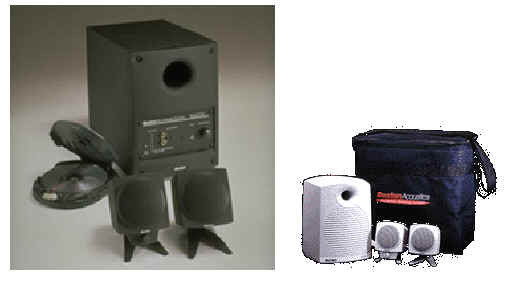
Penghasilan sistem bunyi yang baik, jelas dan realistik antaranya terletak pada sistem stereo bunyi yang digunakan pada sesebuah PC multi media. Misalannya jenama Hewlett Packard (HP) menggunakan sistem stereo Dolby Digital (AC-3) yang kemudiannya direalisasikan oleh pembesar suara (speaker) Premier Polk Audio dan Subwoofer untuk menghasilkan bunyi-bunyian yang realistik dan mengkagumkan.
TETIKUS (MOUSE)
Peranti input komputer yang digunakan sebagai penunjuk untuk mengawal cursor dan untuk memilih objek. Tetikus biasanya mempunyai satu, dua dan tiga butang pada bahagian kepala.
PAD TETIKUS (MOUSE PAD)
Lapik yang diperbuat dari getah untuk melapik dan melancarkan pergerakan tetikus

PAPAN KEKUNCI (KEYBOARD)


Keyboard Housing
Peranti yang mempunyai set kekunci yang mempunyai tanda lambang aksara (character) tertentu yang disusun mengikut cara tertentu dan digunakan untuk memastikan data ke dalam komputer.
Dikeluarkan secara piawai pada tahun 1986 di mana mengandungi 101 key sahaja. Di antara komponen keyboard ialah;
- Dibuat dari plastik yang tidak boleh dilentur/dibengkok untuk mengelakkan komponen dalaman pecah dan kotor (tercemar).
Cables
- Untuk menyambung keyboard ke motherboard (PS/2 port)
Function Button
- Mengandungi 12 kekunci (F1-F12)
- Kebanyakan perisian komputer menggunakan kekunci ini untuk menjalankan sesuatu arahan.
QWERTY Keypad
- Dipanggil demikian mengikut susunan huruf pertama di bahagian atas keyboard iaitu Q, W, E, R, T, Y dan cara menggunakannya sama seperti typewriter.
Editing Keypad
- Membantu untuk edit semasa menggunakan Word Processing (Delete, Home, End dll)
Numeric Keypad
- Memudahkan menaip angka dengan cepat. Fungsi sama seperti culcalator. Mengandungi numeric (0-9), empat basic matematik operators (/, *, -, +), titik perpuluhan dan butang ENTER.
Escape
- Digunakan untuk membatalkan operasi atau keluar dari skrin
ALT/CTRL
- Menggunakan Menu
- Menambah fungsi butang ( Ctrl + S ), (Ctrl + O )
PENCETAK (PRINTER)
Peranti yang menghasilkan data daripada komputer pada kertas. Pencetak boleh digunakan untuk menghasilkan surat atau laporan yang telah ditaip menggunakan komputer.
Pencetak mempunyai dua jenis iaitu dalam bentuk laser dan bubble jet.

DISK DRIVE STORAGE (STORAN)
Storan adalah merupakan tempat di mana perisian-perisian dan data-data disimpan. Storan yang terdapat pada sesebuah komputer terbahagi kepada dua kategori iaitu storan dalaman dan storan luaran. Storan dalaman ialah storan yang dipasang dalam komputer seperti cakera keras, manakala storan luaran adalah storan yang menyimpan data dalam bentuk disket atau pita contohnya disket, pemacu Zip Iomega dan pemacu Jaz Iomega.
Storan diukur dalam ukuran bait (byte) dan sebuah cakera komputer lazimnya mempunyai saiz penyimpanan dalam lingkungan 2.1GB hingga 4GB. Biasanya anda akan mendapat saiz storan sebanyak 2.1GB semasa membeli komputer di pasaran dan ia sudah memadai untuk penggunaan biasa. Bagi memastikan simpanan data yang lebih selamat, anda dinasihatkan untuk mendapatkan satu lagi cakera keras bagi menyimpan data. Langkah ini akan dapat menyelamatkan data tersebut sekiranya cakera keras yang pertama telah rosak.
Floppy Disk Drives
Peranti ingatan berbentuk cakera yang dibuat daripada bahan tipis yang bersalut magnet. Ia digunakan untuk menyimpan data secara magnetik. Disket yang biasa adalah 3.5" boleh menyimpan data sehingga 1.44 MB.

- Mempunyai had keupayaan (capacity) yang berbeza mengikut ukuran.
- 5.25 inci – 360 KB atau 1.22 MB
- 3.5 inci – 720 KB atau 1.44 MB
Hard Disk Drives
- Dipasang di dalam CPU casing
- Tanpa Hard Disk, kita tidak boleh menggunakan ciri-ciri yang ada dalam perisian tersebut.

Pemacu CD-ROM ini digunakan untuk membaca data seperti gambar, bunyi atau video yang terdapat pada sekeping CD-ROM. Ia berfungsi dengan berinteraksi secara terus dengan papan induk melalui sebuah perisian CD-ROM dan kad bunyi. Malah kini terdapat beberapa jenis papan induk yang telah menyediakan port khas untuk CD-ROM dan kad bunyi tidak lagi diperlukan sebagai perantara. Pemacu CD-ROM juga mempunyai kelajuan yang berbeza seperti 8X, 12X, 16X, 24X, 24X dan 100X. Kelajuan ini menggambarkan keupayaannya membaca data-data daripada CD-ROM dalam ukuran nanosaat (ns). Sekiranya anda ingin meningkatkan keupayaan multimedia, mala anda memerlukan sebuah pemacu yang juga berkeupayaan tinggi.

CD-ROM (Compact Disc – Read Only Memory)
- Boleh membaca data tetapi tidak boleh menulis dari Optical Disc
- Menggunakan laser untuk merakam data
- Mempunyai keupayaan yang lebih tinggi dari Floppy Disc
- Sering digunakan sebagai alat multimedia.
- Yang berukuran 12" boleh menyimpan maklumat sebanyak 2 Gigabait
- Single Disc boleh simpan sehingga 650 MB
Tape Drives
- Boleh baca dan tulis data ke dalam memory tape
Catridge Drives
- Boleh baca dan tulis data ke dalam catridge

DVD
Kemunculan DVD di pasaran telah cuba dieksploitasi sapenuhnya dalam PC multimedia terkini bagi merealisasikan segala impian semasa para pengguna. PC multimedia yang dilengkapi dengan pemacu DVD mampu memainkan wayang gambar atau video sehingga kejelasan gambarnya setanding dengan cakera teater di rumah.

Perkakasan atau perisian yang berfungsi untuk menggerakkan perkakasan atau perisian lain.
PEMACU JAZ (JAZ DRIVES)
Peranti yang berfungsi seperti disket tetapi boleh menyimpan data lebih banyak di dalam cakeranya, iaitu 1GB sehingga 2GB.

Drum
Drum bermagnet adalah satu lagi peranti yang boleh digunakan sebagai storan bantuan. Drum ini berbentuk selindir dan disaluti oleh satu bahan bermagnet. Cara maklumat disimpan dan dicapai daripada satu drum adalah hampir sama dengan cara yang digunakan bagi cakera bermagnet.SUMBER:
http://members.tripod.com/upsi_mit/software.html
http://www.ilplabuan.gov.my/download/080425%20ARTIKEL%20SOFTWARE%20-%20azrul.pdf
http://www.ilplabuan.gov.my/download/080425%20ARTIKEL%20SOFTWARE%20-%20azrul.pdf
Subscribe to:
Posts (Atom)